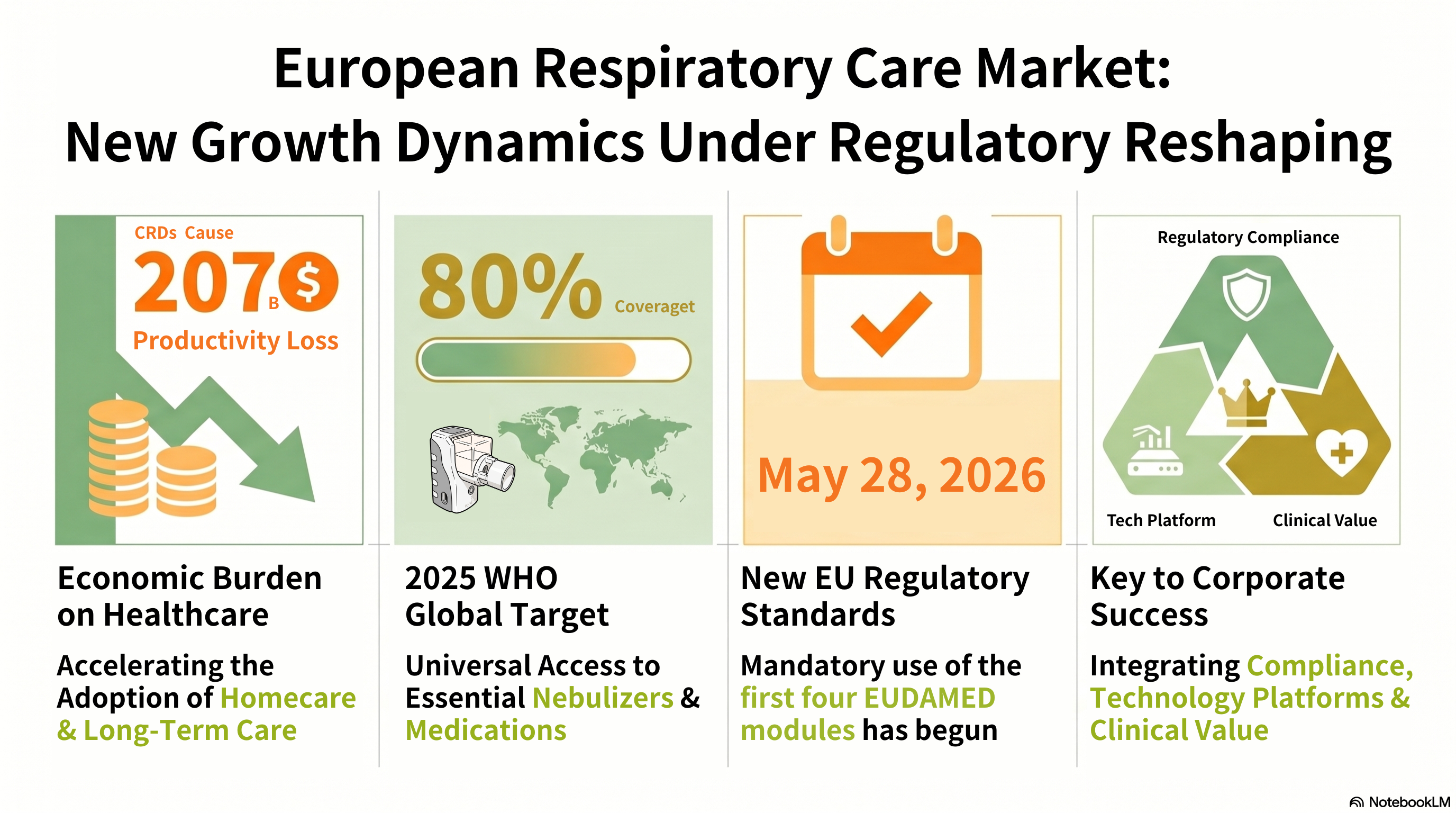
Source : World Health Organization Research Nester Compiled using NotebookLM.
In Europe, chronic respiratory diseases (CRDs) are no longer just a public health issue. They represent a growing healthcare burden that intersects environmental policy, population health, and healthcare system transformation.
According to the World Health Organization (WHO) 2025 European Report on Chronic Respiratory Diseases, the burden of respiratory diseases is highly correlated with smoking, air pollution, and population aging, presenting significant health inequities across different countries.
The implementation of the EU Medical Device Regulation (MDR) and the influx of national innovation funding are accelerating the introduction of advanced respiratory care equipment and driving market development.
Market Transformation: CRD Burden and Policy-Driven Demand
Healthcare systems across Europe are shifting from acute episode management toward preventive care, continuous monitoring, and long-term disease management. This structural shift is generating sustained growth opportunities for respiratory care solutions and medical technologies.
- Expanding Patient Base: The WHO projects that global COPD cases will increase by 23% by 2050. In Europe, an estimated 81.7 million individuals were living with CRDs as of 2021, underscoring a large and growing patient population.
- Macroeconomic Impact: Respiratory conditions contribute to approximately USD 20.7 billion in annual productivity losses across Europe. This economic pressure is accelerating the adoption of cost-efficient care models, including home-based care and long-term disease management solutions.
- Access Targets for Essential Care: Under the WHO's 2025 global target for non-communicable diseases (NCDs), countries are encouraged to achieve 80% availability of essential medicines and core respiratory technologies, such as nebulizers and inhalers.
Regulatory and Funding Drivers: EU MDR as a Market Trust Standard
The implementation of the European Union Medical Device Regulation (EU MDR) is reshaping regulatory expectations and supporting the adoption of advanced respiratory care technologies, including nebulization systems and digitally enabled solutions.
- EU Investment in Innovation: The European Union has committed up to €2.6 billion to support the advancement of respiratory care technologies and digital health integration.
-Germany, the largest respiratory care market in Europe, accounts for approximately 33% of regional revenue. Its statutory health insurance system covers around 93% of respiratory therapies. In addition, government subsidy programs are supporting the adoption of smart medical devices, such as AI-enabled nebulizers, helping advanced solutions reach clinical use more efficiently.
-In the United Kingdom, £2.1 billion has been allocated through digital health funding initiatives to support the development of portable respiratory devices, alongside €315 million dedicated to smart medical technologies. Post-Brexit regulatory reforms have also shortened approval timelines for new devices by approximately 4.5 months. - Advancing Drug–Device Integration: Pharmaceutical and MedTech companies are increasingly developing combination products that integrate active pharmaceutical ingredients (APIs) with precision delivery devices. This reflects the growing importance of integrated drug-device solutions in respiratory care.
Annual productivity loss in Europe accelerating homecare and long-term care adoption.
Universal access target for essential nebulizers and medications.
Mandatory registration begins; integrating compliance and tech is key to success.
Regional Dynamics Across Europe
The adoption of respiratory care technologies and treatment approaches varies across Europe, influenced by differences in reimbursement systems, digital health policies, and diagnostic capacity.
- Western & Central Europe — Leading in Digital Health and Self-Management
These regions are leading in the use of digital tools such as mobile health applications, telehealth services, and smart inhalers to support patient self-management. As a result, despite relatively high disease prevalence, mortality rates are comparatively lower. - Eastern Europe — Developing Markets with Strong Growth Potential
Eastern Europe shows lower diagnosis rates but disproportionately higher mortality, reflecting gaps in healthcare resources and delayed treatment. Adoption of digital health and patient self-management solutions remains limited, indicating early-stage market development with strong future potential.
Respiratory Care Solutions: Integrating Regulatory, Technology, and Clinical Value
The European respiratory care market is entering a new phase shaped by growing demand, evolving regulations, and ongoing technological progress. With the EU EUDAMED module registration now mandatory since May 28, 2026, companies need to align regulatory compliance, technology capabilities, and clinical value.
Organizations that can adapt their strategies to different healthcare systems and levels of market maturity across Europe will be better positioned to achieve sustainable and sca lable growth.